May 14, 2026
WHEN WATER IS THE TOPIC, THE BUILDING IS PART OF THE SCIENCE
People usually arrive at a fluoride-in-water discussion through public health: dental outcomes, dosage, equity, and long-term exposure. What gets less attention is the moment water stops behaving like “tap water” and starts behaving like a building problem. A burst pipe, a flooded basement, a roof leak that runs behind the walls. In those moments, the questions change fast: what was in that water, what did it touch, what’s now airborne, and how do we make the space safe again?
That overlap is why we talked to the owner of Boston Water Damage Restoration while putting this piece together. Their team sees the real-world edge cases that rarely show up in abstract debates: families displaced by a leak, schools dealing with soaked materials, and homeowners trying to decide what needs professional remediation versus what can be handled with careful cleanup.
This article bridges fluoride-in-water concerns with a practical reality: the quality and safety of water is not only about treatment levels. It is also about what happens when water leaves the pipe, saturates a structure, and changes the indoor environment.
1) FLUORIDE CONVERSATIONS START WITH CONCENTRATION, NOT CONFUSION
Fluoride discussions can get emotionally charged because they sit at the intersection of health, trust, and policy. A helpful way to keep the conversation grounded is to separate three ideas: the recommended target level for community water systems, higher levels that may increase the likelihood of dental fluorosis during tooth development, and much higher levels that trigger regulatory concern.
In the United States, the U.S. Public Health Service recommendation commonly referenced by public health sources is 0.7 mg/L as a level intended to maximize cavity prevention benefits while minimizing the risk of dental fluorosis. The CDC’s overview of community water fluoridation recommendations summarizes that guidance clearly here: https://www.cdc.gov/fluoridation/about/community-water-fluoridation-recommendations.html.
That baseline matters because it frames the rest of the discussion. Most people are not interacting with “unknown chemistry.” They are interacting with a system that targets a specific concentration, measured and monitored, with ongoing debate focused on policy choices, cumulative sources, and individual risk tolerance.
2) WHEN WATER BECOMES “WATER DAMAGE,” THE RISK PROFILE CHANGES
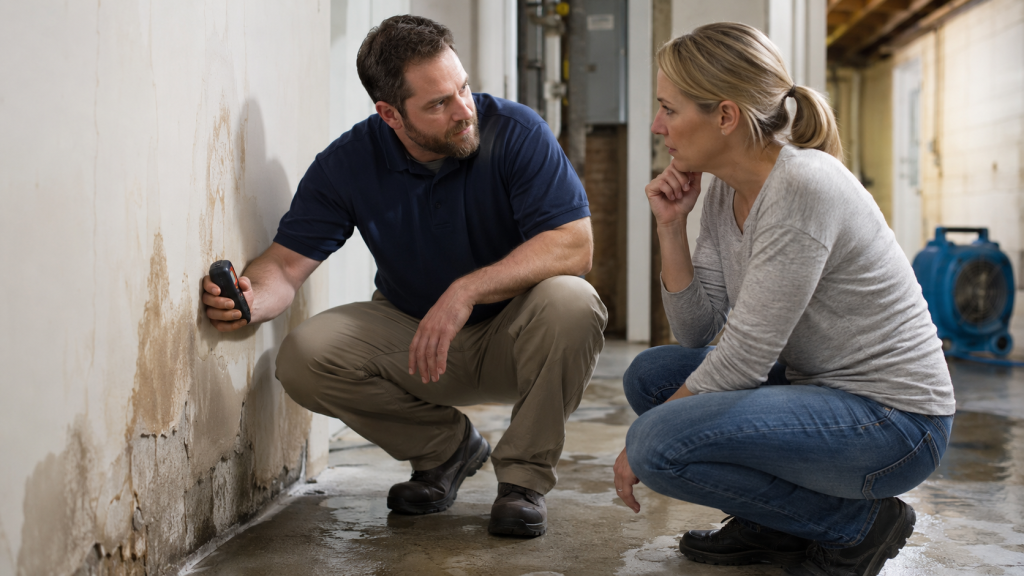
Now shift the scenario. The issue is no longer the fluoride level in a glass of water. The issue is water where it does not belong: behind drywall, under flooring, inside insulation, or pooled in a basement. That changes what you need to think about, because the primary health risks often become microbial growth, particulate contamination, and long-term moisture problems that alter indoor air.
In other words, the biggest health question after a leak is usually not “what was the fluoride level.” It’s “what is going to grow here, what is going to linger, and what is going to get into the air we breathe.”
The owner we spoke with described it simply: clean water does not stay clean once it moves through building cavities and porous materials. It picks up debris, contacts dust, and leaves behind moisture in spaces that were never designed to dry quickly. This is where prompt, methodical restoration matters, because time is the enemy of indoor health after a water event.
3) THE “HIDDEN” HEALTH EFFECTS OF MOISTURE: WHY DRYING IS A HEALTH DECISION
A surprisingly common misconception is that if something looks dry, it is dry. Building materials can hold moisture deep inside, and that moisture can persist long enough to create conditions for mold growth or other indoor air quality issues.
The EPA’s guidance on mold and moisture emphasizes the practical core of prevention: control moisture, dry promptly, and fix the underlying water problem so the issue does not repeat. This guide is a strong reference point for why drying and remediation are part of health protection, not just cosmetic repair: https://www.epa.gov/mold/brief-guide-mold-moisture-and-your-home.
For readers of a fluoride-focused publication, this matters because it expands the water conversation. Water affects health through chemistry, yes. But it also affects health through physics and biology when it changes the indoor environment.
4) WHAT RESTORATION PROFESSIONALS ACTUALLY DO AFTER A WATER EVENT
A good restoration workflow is not simply “remove the wet stuff.” It’s a sequence designed to prevent secondary harm: trapped moisture, persistent odor, recurring microbial growth, and compromised materials that keep shedding particles.
From the perspective of Boston Water Damage Restoration, the most important steps are often the least visible: moisture mapping, controlled drying, and verification. That is especially true in older buildings where water can travel along framing, wick into plaster, or settle into low points that never fully dry without intervention.
This is also where trust and documentation matter. If a family has concerns about water quality or chemical exposure, a clear remediation record helps them understand what happened, what was removed, what was dried, and what was tested for moisture before the space was returned to normal use.
5) BRIDGING THE “WATER QUALITY” MINDSET WITH THE “BUILDING HEALTH” MINDSET
Fluoride discussions often revolve around long-term, low-dose exposure. Water damage conversations are usually short-term, high-disruption events. But the bridge between them is the same core principle: dose and duration matter, and context changes risk.
A few examples make this easier to see:
- A stable municipal water supply can be managed through monitoring and public reporting.
- A water-damage event is chaotic, and the variables multiply quickly: source, category, contact surfaces, time-to-dry, and whether materials were removed or sealed.
- After a major leak, the bigger health lever is often indoor air management and moisture control, because that affects daily exposure immediately.
This is not a reason to dismiss fluoride questions. It’s a reason to recognize that “water and health” is bigger than a single parameter.
6) A PRACTICAL CHECKLIST FOR READERS WHO WANT ACTIONABLE GUIDANCE
If you want a health-first approach that respects both water quality and indoor environment risk, these steps are a strong starting point after any significant water event:
- Identify the source and stop it, then document what happened and when.
- Assume porous materials may hold moisture longer than they appear to.
- Prioritize fast drying and dehumidification, especially in wall cavities and under flooring.
- Remove materials that cannot be reliably dried or that have been contaminated.
- Fix the underlying cause, including drainage, plumbing, or envelope issues, to prevent recurrence.
- Use reputable restoration professionals when the affected area is large, hidden, or time-sensitive.
This is the kind of practical, prevention-oriented work that restoration teams do daily, and it aligns with the broader public health principle behind water discussions: reduce avoidable exposure, and reduce avoidable uncertainty.
7) THE TAKEAWAY: WATER SAFETY IS A SYSTEM, NOT A SINGLE NUMBER
Fluoride debates often focus on a number in a report. Water damage forces us to see the full system: infrastructure, building materials, indoor air, and human behavior under stress. Both perspectives matter, and both benefit from calm, evidence-based thinking.
If we want the healthiest outcome for communities, we should treat water as more than a treatment topic. We should treat it as a lifecycle topic, from distribution to the moment it interacts with our living spaces. That is why conversations about fluoride-in-water and conversations about restoration after leaks can sit in the same article without feeling forced. They are both about preventing harm, using good information, and responding appropriately when conditions change.
 If you are a dentist, it’s highly recommended that you consider